

When NASA launched Artemis II on April 1, 2026, it sent four astronauts into the deep-space radiation environment for the first time since the Apollo program. Beyond Earth’s magnetic shelter, the crew faced three overlapping radiation hazards: Van Allen belt particles, unpredictable solar particle events, and a chronic background of galactic cosmic rays. ANSTO radiation dosimetry expert Dr Mitra Safavi Naeini explains what was being measured — and why no single number can capture it.
On the first of April 2026, NASA sent four astronauts farther from Earth than any humans have travelled since the Apollo program.
Commander Reid Wiseman, pilot Victor Glover, and mission specialists Christina Koch and Jeremy Hansen of the Canadian Space Agency launched aboard the Orion spacecraft — named Integrity — atop the Space Launch System rocket, bound for a ten-day lunar flyby.
The images they captured will be remembered. But for the scientists and engineers working on deep space medicine, the data that matters most from this mission isn’t photographic — it’s radiological.
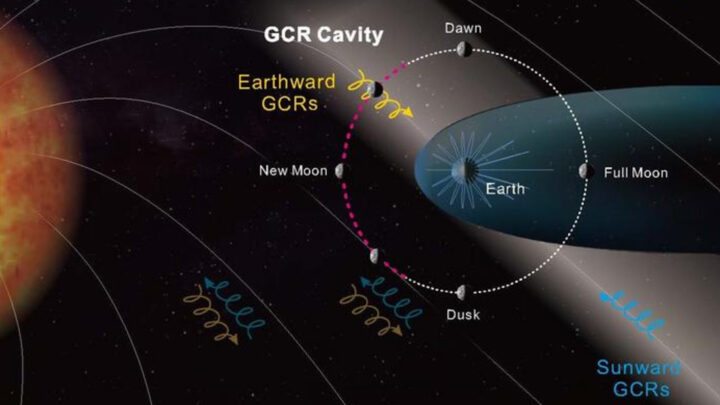
ANSTO radiation dosimetry expert Dr Mitra Safavi Naeini explains why. Beyond Earth’s protective magnetic field, astronauts face three distinct radiation environments that don’t exist in low Earth orbit. First, the Van Allen belts — regions of trapped energetic particles that the spacecraft crosses quickly, but which deliver an intense brief dose. Second, solar particle events — bursts of high-energy protons from solar flares that can dramatically spike radiation levels over hours, requiring fast operational responses. And third, galactic cosmic rays — a chronic, ever-present flux of extremely high-energy particles, mostly protons but also heavy ions, that stream in from outside the solar system and are notoriously difficult to shield against.
Artemis II launched during the aftermath of Solar Cycle 25’s activity maximum, which creates a particular paradox. Around solar maximum, the elevated solar wind actually partially suppresses the galactic cosmic ray background — because solar magnetic activity deflects some of that incoming flux. But the probability of a disruptive solar particle event is simultaneously higher. So the two main long-duration hazards trade off against each other depending on the solar cycle phase.
And that’s just the first layer of complexity. Radiation protection in deep space isn’t simply an engineering problem of adding more shielding. For solar particle events, additional shielding material does help considerably. But for galactic cosmic rays, the picture is more counterintuitive. When very high-energy heavy ions strike a spacecraft wall — or a human body — they can fragment, generating secondary particles including neutrons. More shielding material can actually mean more secondary radiation, which in some configurations is worse than less shielding. Radiation protection is therefore simultaneously a materials problem, a geometry problem, and an operations problem.
Artemis I demonstrated this concretely. That uncrewed mission found that dose levels within the Orion cabin varied significantly by location — and that a change in spacecraft orientation during a thruster burn reduced measured radiation levels inside by nearly half.
Artemis II is the first mission to map this geometry with crew on board. Along with the four astronauts, Orion carried cabin-mounted radiation monitors, crew-worn dosimeters, an upgraded German M-42 EXT heavy-ion detector, organ dosimetry devices, and biomedical sampling kits for collecting saliva and blood to track immune biomarkers across the flight.
The scientific picture being assembled isn’t just about this mission. It’s about every mission that comes after.