

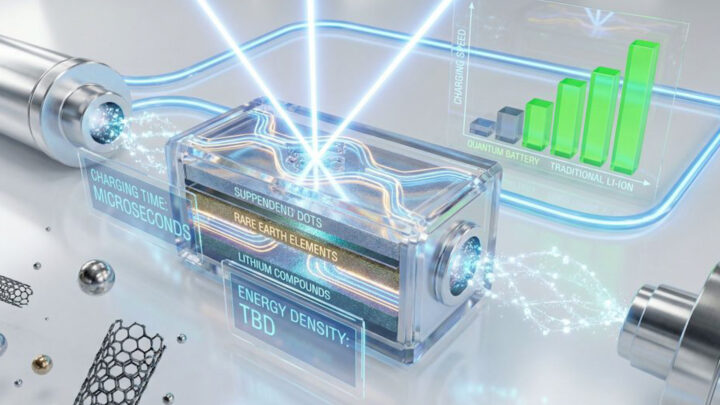
A team from CSIRO, RMIT University, and the University of Melbourne has demonstrated the world’s first proof-of-concept quantum battery — a device that charges, stores, and releases energy using the strange rules of quantum mechanics. Unlike conventional batteries, this one becomes faster to charge as it grows larger, a counterintuitive property that could one day power electric vehicles or quantum computers.
Imagine charging your electric car faster than it takes to fill a tank of petrol. Or wirelessly powering a device from across a room. That’s the long-term dream behind a genuinely exciting result just out of Australia — the world’s first proof-of-concept quantum battery that completes a full charge, store, and discharge cycle.
The research comes from a collaboration between CSIRO, RMIT University, and the University of Melbourne, published in the journal Light: Science and Applications.
So what actually is a quantum battery? Unlike conventional batteries, which rely on chemical reactions, quantum batteries exploit the strange properties of quantum mechanics — things like superposition and the interaction of light with matter at the quantum scale. Rather than shuffling ions back and forth, you’re trapping photons inside a microscopic cavity to excite molecules and store energy in quantum states.
The prototype the team built uses a multi-layered organic microcavity and is charged wirelessly using a laser. Advanced spectroscopy confirmed it works — and revealed something counterintuitive that’s been theorised for years but never experimentally verified: quantum batteries charge faster as they get larger. That’s the opposite of conventional batteries, where bigger capacity means longer charging times. This scaling effect is called superextensive charging, and the prototype demonstrates it in the real world for the first time.
The device also retained stored energy for six orders of magnitude longer than it took to charge — which is a striking result, even if that storage window is currently measured in nanoseconds.
And yes, nanoseconds is the reality check here. The total energy capacity of the prototype is tiny — we’re talking a few billion electron-volts. You’re not going to run a fridge off it anytime soon. But the technology might not be aiming for your fridge. One of the most compelling near-term applications is powering quantum computers themselves, which need precisely controlled energy at quantum scales. Quantum batteries may turn out to be ideally suited for that specific job.
The team at CSIRO has already been making progress on extending charge retention. By July 2025, RMIT and CSIRO had pushed the charge lifetime from nanoseconds to microseconds — a thousand-fold improvement. And importantly, the prototype operates at room temperature, which sidesteps the expensive cryogenic cooling required by many other quantum approaches.
Dr James Quach, who led the engineering effort at CSIRO, has been clear that there’s significant work still to do. But validating the fundamental quantum physics in a real device is a major step — it moves quantum batteries from theoretical curiosity to something engineers can actually start designing around.
CSIRO is now actively seeking industry development partners. The era of quantum energy storage may be a long way off, but its foundations were just poured, right here in Australia.