

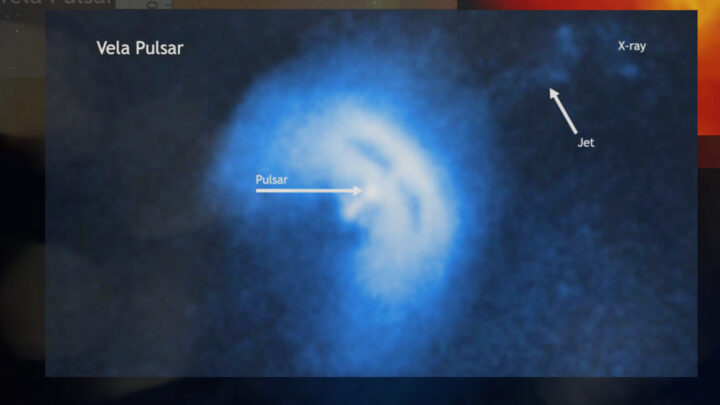
In more SKA news, Observations of pulsars – rapidly spinning dead stars – are helping the SKA Observatory to prepare for early science operations. The Observatory has released one of these observations made with an early version of the SKA-Low telescope, as scientists work to fine-tune the sensitivity of the growing array
Pulsars are rapidly spinning neutron stars with strong magnetic fields. Their rapid and regular rotations make them incredibly precise space clocks, as accurate as the best atomic clocks on Earth.
The Vela pulsar is one of the brightest pulsars in the Southern sky and, at about 900 light years away, one of the closest to Earth. It’s one of a growing catalogue of close to 50 known pulsars so far observed as part of the commissioning phase of SKA-Low, which is under construction on Wajarri Yamaji Country in Western Australia.
SKA-Low’s two-metre-tall antennas are grouped into “stations” of 256 antennas each; this observation used four complete stations, comprising 1,024 antennas in total. As more and more antennas are added to the telescope, teams are commissioning and calibrating stations individually, and ensuring they work together as one big telescope.
The pulsar data release comes just a couple of months after the first image from these four stations was released in March.