

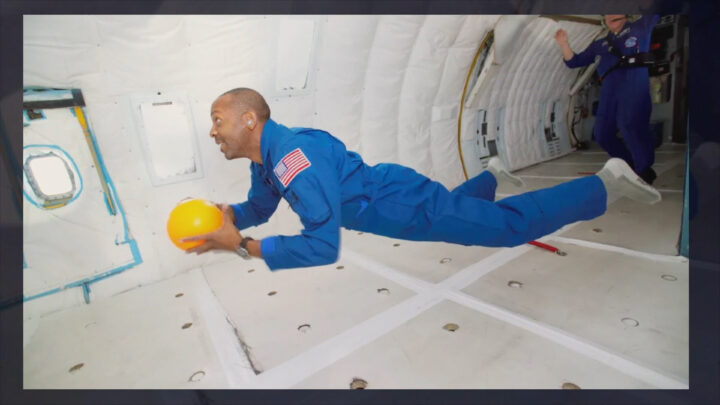
A study two decades in the making has revealed that the human brain’s model of gravity is so deeply embedded that it persists — and misfires — long after astronauts enter microgravity. Researchers from Université catholique de Louvain found that astronauts consistently over-grip objects in space because their brains still anticipate Earth’s gravitational pull, and that the process reverses imperfectly on return, with mis-calibrated grip force taking days or weeks to correct.
Here’s something that might seem obvious once you hear it, but turns out to be genuinely fascinating once you dig into the neuroscience — when astronauts come back from months in space, their brains have forgotten how to hold things.
A study published in the Journal of Neuroscience, led by Philippe Lefèvre and colleagues at Université catholique de Louvain and the Ikerbasque research foundation in Spain, has spent close to 20 years collecting and analysing data on exactly this phenomenon. And the results reveal just how deeply gravity is embedded in the brain’s predictive model of the physical world.
On Earth, when you pick up an object, your brain doesn’t just react to what it feels — it pre-emptively calibrates your grip based on its prediction of how gravity will affect the object. It loads in a model of downward force before your fingers even register the weight. That prediction is so fundamental that it persists even after months of living in microgravity.
In space, objects don’t fall when you let go. But inertia is still very much in play — if you move an object quickly, it keeps moving in a straight line when you stop, which can send it floating off into the cabin. So the brain faces a novel problem: grip isn’t needed to prevent falling, but it’s still needed to control motion. The study found astronauts consistently over-grip objects during movement in microgravity — because their brain’s deep-seated gravity model is still telling them to account for a downward pull that isn’t there.
The effect was most pronounced when objects were being actively moved rather than simply held in place. And it wasn’t just extra grip — it was excess muscle effort, the hands working harder than necessary because the brain’s predictions were calibrated for an environment it was no longer in.
The reverse problem emerges on return to Earth. After months of adaptation to a zero-gravity grip strategy, astronauts land back on the surface and suddenly face a world of weight again. For the first few days, they tend to under-calibrate — misjudging the force needed to control objects because the revised model takes time to re-converge on the correct predictions. The brain doesn’t flip a switch; it adjusts gradually, over days to weeks, as real sensory feedback corrects the predictions.
The human body is remarkably adaptable. But gravity leaves a deep imprint.