

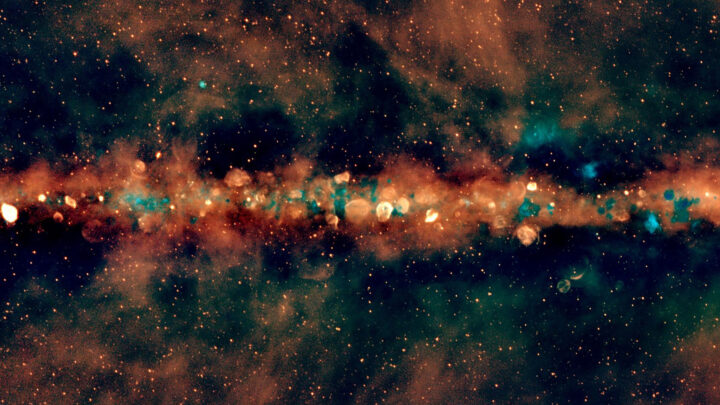
Astronomers from the International Centre of Radio Astronomy Research have created the largest low-frequency radio colour image of the Milky Way ever assembled.
Which provides astronomers with new ways to explore the birth, evolution, and death of stars in our Galaxy.
Silvia Mantovanini, a PhD student at the Curtin University node of ICRAR, dedicated 18 months and over 40,000 hours to construct the image by using the supercomputers at the Pawsey Supercomputing Research Centre to process and compile the data from two extensive surveys.
Those were conducted using the Murchison Widefield Array telescope located at the CSIRO Murchison Radio-Astronomy Observatory on Wajarri Yamaji Country in Western Australia.
These were the GaLactic and Extragalactic All-sky MWA – or GLEAM – and the GLEAM extended – or GLEAM-X – surveys respectively conducted over 28 nights in 2013 and 2014, and 113 nights from 2018 to 2020.
The new image, which focuses on our own Galaxy, offers twice the resolution, ten times the sensitivity, and covers twice the area compared to the previous GLEAM image released in 2019. This significant improvement in resolution, sensitivity and sky coverage allows for a more detailed and comprehensive study of the Milky Way, providing astronomers with a wealth of new data and insights.
The image allows them to distinguish between the gas surrounding new stars and that left behind by dead ones, revealing clearer patterns in the cosmic landscape.