

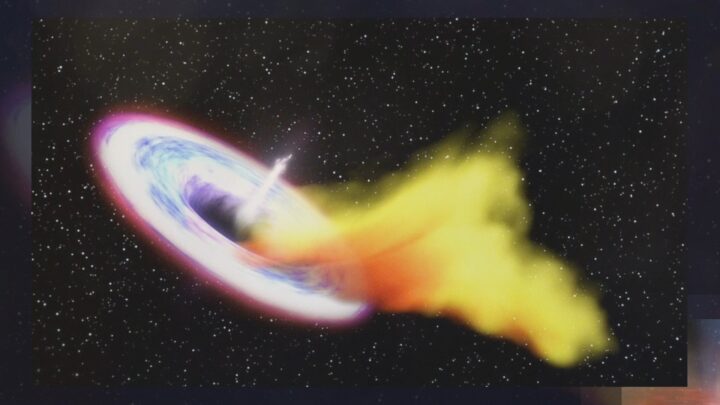
One of the most powerful black holes in the universe is belching out gas at speeds of up to 10,000 kilometres per second, making its estimated mass more than 10 times lower than first thought.
The monster black hole was first discovered by Associate Professor Christian Wolf and his team at The Australian National University in 2024 and, using brand-new powerful optical equipment at the European Southern Observatory in Chile, researchers have now been able to magnify the black hole’s light and get a closer look at the gas swirling around it.
“Instead of rapidly rotating as previously presumed, this black hole is belching up the gas it’s feeding on. The gas is being blown away by the ferocious density of light — this is the brightest object in the universe we know of.” Associate Professor Christian Wolf at the ANU said.
The black hole is more than 12 billion light-years away, making it challenging to study its inner structure — until now. Concurrently, Professor Michael Ireland from ANU is helping ESO advance its interferometry technology even further, meaning that it can soon be used to look at many more objects across the sky in even greater detail.
This study was a collaboration with the Max-Planck-Institute for Extraterrestrial Physics in Germany.