

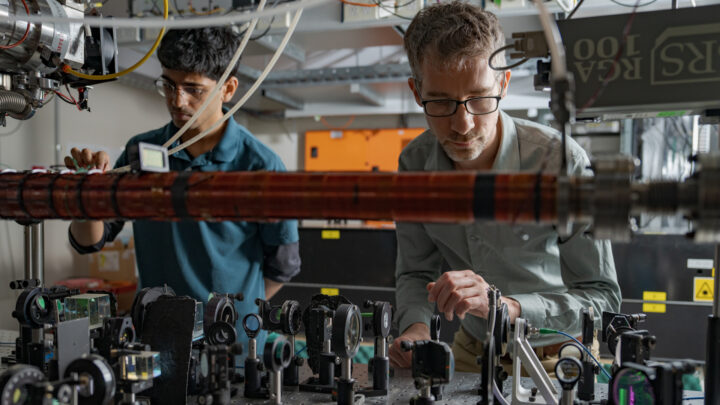
Physicists at the Australian National University have observed pairs of helium atoms in a genuine quantum superposition — simultaneously existing in two locations while entangled in motion. It’s a result that had eluded researchers worldwide for years, and one that opens a new experimental window into one of physics’ deepest unsolved questions: how does quantum mechanics connect with gravity?
If you’ve ever been told that quantum mechanics is just too weird to wrap your head around, this story is not going to help.
Because researchers at the Australian National University have just observed something that challenges every intuition about how physical objects behave — pairs of helium atoms simultaneously existing in two places at the same time, while entangled in motion.
The results were published in Nature Communications.
Now, quantum superposition — the idea that a particle can exist in multiple states or locations until it’s observed — has been demonstrated many times before. But those experiments have almost exclusively used photons, particles of light. Photons are massless. They don’t experience gravity. They’re relatively easy to isolate from the environment.
Atoms are a completely different challenge. They have mass. They interact with gravity. And mass means a richer set of interactions that can disrupt the delicate quantum state you’re trying to preserve. That’s why, as lead author and PhD researcher Yogesh Sridhar explained, many groups around the world have attempted to show these effects in massive particles over the years — and consistently fallen short.
The ANU team used helium atoms in a metastable excited state, cooled and manipulated to demonstrate what physicists call Bell correlations — statistical signatures that confirm the atoms were genuinely quantum entangled in their momentum, not just classically correlated. These Bell correlations are the gold standard for proving real quantum entanglement rather than a classical mimicry of it.
What this means practically is that both atoms shared a quantum state — a superposition where their positions and momenta were simultaneously undefined, existing in a kind of spread-out quantum reality across two locations at once. And when one was measured, the measurement instantly described the other, no matter the distance. As Dr Sean Hodgman from the ANU Research School of Physics put it — it really is as strange as it sounds. Reading about it in a textbook doesn’t prepare you for what it means when you actually observe it in the lab.
The significance reaches well beyond the novelty factor. This result opens a new experimental platform for investigating one of the deepest unresolved questions in physics: how does quantum mechanics — which governs the smallest scales of reality — interface with gravity and general relativity, which governs the largest? These two frameworks currently can’t be reconciled within a single theory. Massive particles in quantum superposition are exactly the kind of system that might reveal where and how those two descriptions break down and connect.
Whether this nudges us closer to a unified “Theory of Everything” remains to be seen. But for the first time, we have a tool — massive, gravity-sensitive atoms in confirmed quantum entanglement — that just might let us ask the question experimentally.