

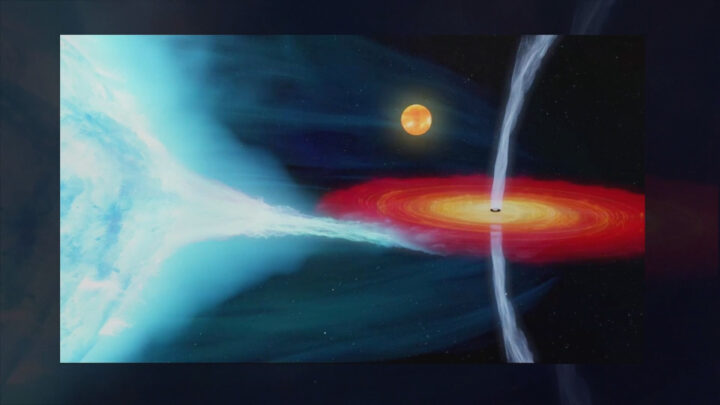
A Curtin University-led research team has made the first-ever direct measurement of the instantaneous power of jets from a black hole. Using a radio telescope network spanning the Earth to observe the famous Cygnus X-1 binary system, researchers tracked the black hole’s “dancing jets” — bent by its companion star’s stellar wind — and calculated a power output equivalent to 10,000 Suns, with the jets travelling at half the speed of light.
For the first time, scientists have measured the instantaneous power of jets blasting out of a black hole. And the number is staggering — the equivalent of 10,000 Suns.
The result comes from Curtin University-led research published in Nature Astronomy, focusing on one of the most famous objects in the sky: Cygnus X-1. Located about 7,200 light-years away in the Milky Way’s Cygnus constellation, It’s distinguished by being the first black hole ever confirmed — identified back in the 1960s. It’s paired with a blue supergiant companion star, and the two orbit each other in a slow gravitational dance, with the star constantly shedding gas that spirals down toward the black hole.
The black hole — which tips the scales at around 21 solar masses — produces powerful jets of plasma that blast outward from its poles at roughly half the speed of light. That translates to about 150,000 kilometres per second, or around 540 million kilometres per hour. And now, thanks to some clever observational physics, we know those jets carry away energy at a rate equivalent to 10,000 times what our Sun produces.
Lead researcher Dr Steve Prabu, who carried out the work while at Curtin’s Institute of Radio Astronomy and has since moved to the University of Oxford, described the jets as “dancing” because they don’t point in a fixed direction. As the black hole orbits its companion, the supergiant star’s powerful stellar wind continuously pushes the jets around, bending them like a fountain in a strong breeze. That variation is exactly what the team exploited.
The researchers used a technique called very long baseline interferometry — linking radio telescopes separated by vast distances across the Earth to effectively create an instrument as large as the planet itself. This gave them the angular resolution to track the jets’ changing orientation over time. By knowing the measured properties of the stellar wind and calculating how much the jets were bent by that wind, they could work out the instantaneous jet power from first principles.
Before this, measurements of black hole jet power had to be averaged over timescales of thousands to even millions of years, using indirect methods. The new approach gives you the power right now — which means it can be directly compared to the X-ray energy being released simultaneously from infalling matter.
And because the physics around black holes scales consistently across size ranges, this result applies equally well to black holes tens of millions of times more massive than Cygnus X-1.