

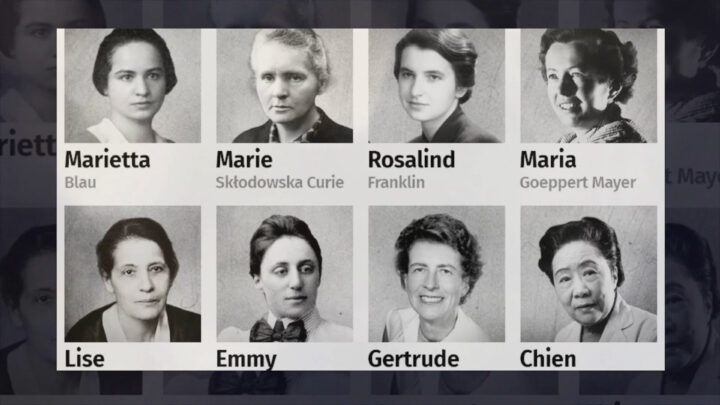
To mark International Women’s Day, ANSTO published profiles of eight pioneering women whose discoveries underpin the physics and chemistry used at the organisation today. From Marietta Blau’s nuclear emulsions to Rosalind Franklin’s Photograph 51 to Lise Meitner’s co-discovery of fission, the stories share a common thread: transformative science done without credit, pay, or prizes that went to the men who followed.
To mark International Women’s Day, ANSTO — the Australian Nuclear Science and Technology Organisation — published profiles of eight pioneering women scientists. whose work underpins the physics and chemistry used at the organisation today.
Their stories are worth telling.
Marietta Blau spent fifteen years developing nuclear photographic emulsions. In 1937, she and Hertha Wambacher placed emulsion plates high on an Austrian mountain and discovered starbursts of particle tracks radiating from a single point. They were seeing cosmic ray particles disintegrating heavy nuclei in the emulsion — the first direct observation of nuclear disintegration by cosmic rays. Blau was later forced out of her university position by the Nazis, and her nomination for the Nobel Prize was overlooked.
Lise Meitner co-discovered nuclear fission. She worked alongside Otto Hahn for decades but fled Germany in 1938, smuggled across the Dutch border by colleagues after the Nazi annexation of Austria stripped her of her protections. When the Nobel Prize in Chemistry for the discovery of fission was awarded in 1944, it went to Hahn alone.
Rosalind Franklin’s contribution to the discovery of DNA’s double helix is by now widely known, though not widely enough. Working at King’s College London, she optimised X-ray crystallography techniques to produce Photograph 51 — the clearest image yet obtained of B-form DNA. James Watson and Francis Crick were shown that photograph without her knowledge. Their landmark paper appeared in Nature in April 1953. Franklin’s name was not on it. Rosalind Franklin died in 1958, aged 37.
Maria Goeppert Mayer worked out why certain atomic nuclei are exceptionally stable. She carried out much of this work as an unpaid volunteer, barred from salaried positions by anti-nepotism rules because her husband held faculty appointments at the same institutions. She received her first paid professorship in 1960 and the Nobel Prize in Physics in 1963.
And Chien-Shiung Wu. In 1956, physicists Lee and Yang proposed an experiment to test whether the weak nuclear force actually respected left-right symmetry — parity conservation — which had been assumed to hold universally. She cancelled a planned trip abroad to pursue the potential and her cobalt-60 beta decay experiment overturned one of physics’ most fundamental assumptions. Lee and Yang received the Nobel Prize in Physics in 1957. Wu did not.
The science these women built is woven into the tools ANSTO uses every day. Their names should be equally familiar.