

An astronomical instrument featuring Australian-built technology has achieved first light – the crucial moment when a telescope captures its first images – at the European Southern Observatory’s Paranal Observatory in Chile.
The 4MOST – or the 4-metre Multi-Object Spectroscopic Telescope – facility uses an optical fibre positioning system built by Macquarie University’s Australian Astronomical Optics (AAO), allowing the telescope to simultaneously observe thousands of celestial objects, from stars and planets to nebulae and black holes.
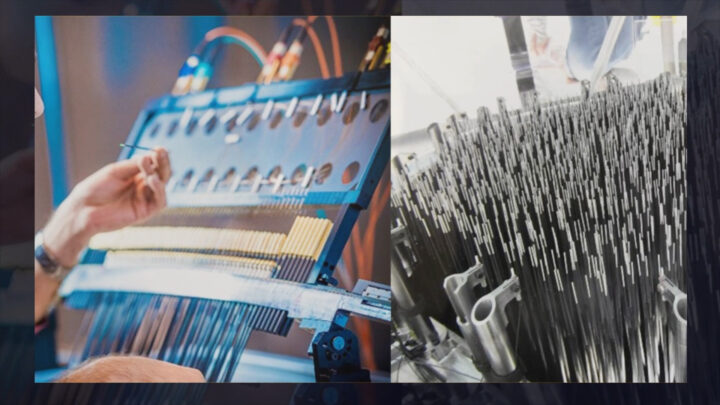
At the heart of 4MOST sits AESOP – the Australian-European Southern Observatory Positioner, the robotic fibre positioning system designed and built by AAO. AESOP can position 2438 optical fibres with 10-micron accuracy (about 0.01 millimetres, or one-seventh the width of a human hair) in under one minute. Each fibre captures light from a different star, galaxy or other celestial object, feeding it to spectrographs that analyse the light in detail.
Key team members involved in the historic installation included Helen McGregor, AAO’s mechanical group manager; Scott Smedley, the AESOP project manager; Slavko Mali, electronics technician; and Dylan Simpfendorfer, junior mechanical engineer.
The project brought together a consortium of 30 universities and research institutes across Europe and Australia, led by the Leibniz Institute for Astrophysics Potsdam. The 4MOST science team includes more than 700 investigators worldwide.
While many telescopes simply photograph the sky, 4MOST breaks down the light from each object into its component colours – a spectrum – revealing information invisible in ordinary images. Astronomical spectra work like cosmic fingerprints, revealing what an object is made of, how hot it is and how fast it is moving through space.