

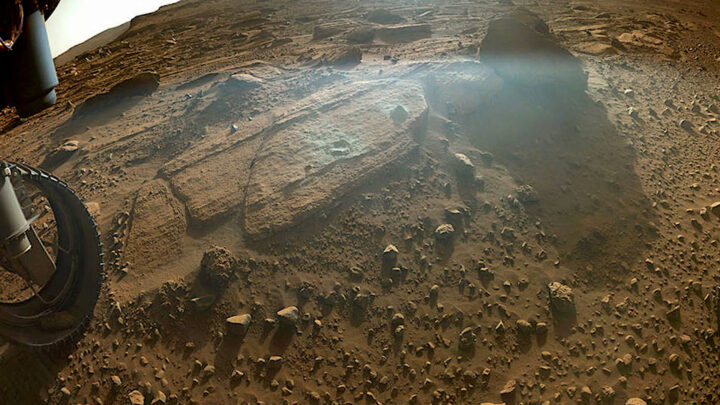
Data from NASA’s Perseverance rover has revealed unusually high concentrations of nickel in the ancient Neretva Vallis river channel on Mars — the highest ever detected in Martian bedrock. On Earth, nickel at these levels is often associated with ancient microbial life, and its co-location with iron-sulfide minerals and organic compounds is raising eyebrows in the astrobiology community.
NASA’s Perseverance rover has turned up something unexpected in an ancient Martian river channel and while scientists are careful not to oversell what it means, it’s hard not to sit up and pay attention.
The finding, published in Nature Communications, comes from analysis of data collected during Perseverance’s traverse through Neretva Vallis in 2024. That’s an ancient river channel that once carried water into the Jezero crater — a 45-kilometre-wide basin that’s believed to have held a lake roughly three billion years ago.
Researchers from Purdue University, led by Henry Manelski, found something unusual in the rock composition data. Of 126 distinct rock targets analysed using Perseverance’s SuperCam instrument — which uses Laser Induced Breakdown Spectroscopy to remotely vaporise tiny rock samples and read their elemental composition — 32 showed nickel concentrations of up to 1.1 percent by weight. That’s the highest abundance of nickel ever detected in Martian bedrock, and significantly above what you’d normally expect, given that nickel tends to sink into a planet’s core during formation.
So why does nickel matter? On Earth, nickel is an essential element for many microorganisms. It plays a critical role in the Wood-Ljungdahl pathway — an ancient, energy-efficient anaerobic process used by certain bacteria and archaea to fix carbon dioxide. Life around 3.5 to 4 billion years ago, roughly the same era as Jezero crater, was dominated by exactly these kinds of anaerobic microbes.
The nickel in these Martian rocks appears concentrated in iron-sulfide minerals that are chemically and morphologically similar to pyrite found in ancient sedimentary rocks on Earth — rocks that on our planet are often used as evidence that early Earth’s atmosphere was oxygen-poor, and that microbial life was active in those environments.
Crucially, the nickel-rich zones are co-located with organic compounds — carbon-containing molecules — and with redox-sensitive minerals that indicate active chemical cycling. On Earth, that combination raises the interest level considerably.
Now, the team is explicit: none of this proves life existed on Mars. Nickel can accumulate through purely geological processes — hydrothermal activity, impacts, specific alteration pathways. And any biosignature interpretation has to be consistent with the full geochemical and geological context.
But what it does do is add another line of evidence that Neretva Vallis, and Jezero crater more broadly, hosted the kinds of chemical conditions that, on Earth, tend to coincide with biological activity. And it makes the rock samples Perseverance is collecting for eventual return to Earth that much more compelling.
Mars keeps yielding fragments of a story that isn’t finished yet. And scientists, to their credit, are keeping their conclusions exactly as tentative as the data demands.