

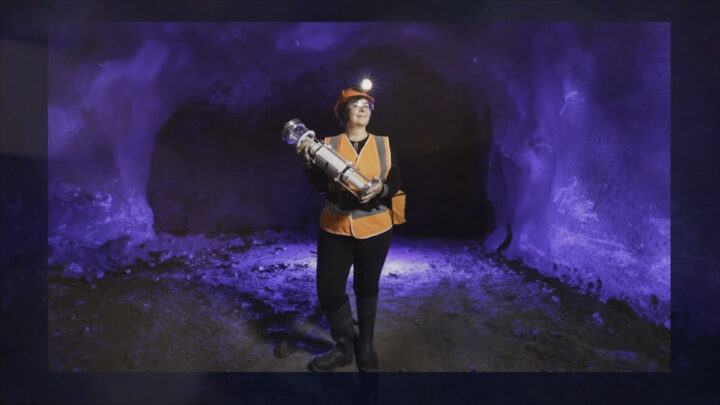
The Stawell Underground Physics Laboratory in regional Victoria — the Southern Hemisphere’s first deep underground physics lab — has confirmed that cosmic radiation levels inside are low enough to support its dark matter search. Scientists measured just 30,000 cosmic muons inside over the course of a year, compared to the 8.4 billion that would be expected at the surface. The SABRE South experiment is set to begin taking data before the end of 2026.
Deep beneath the goldfields of regional Victoria, about a kilometre underground inside the old Stawell Gold Mine, Australia’s first — and the Southern Hemisphere’s first — deep underground physics laboratory has just passed a critical test on its way to hunting dark matter.
The Stawell Underground Physics Laboratory was constructed in 2022 to house the SABRE South experiment, which stands for Sodium Iodide with Active Background Rejection. And in the first paper published from the facility scientists from the ARC Centre of Excellence for Dark Matter Particle Physics have confirmed that cosmic radiation levels inside the lab are low enough to support a sensitive dark matter search.
Dark matter is the invisible substance that outweighs ordinary matter in the universe by a factor of roughly five to one. We know it exists from its gravitational effects on galaxies and the large-scale structure of the cosmos, but we’ve never directly detected it. Experiments searching for dark matter require extraordinarily quiet environments, shielded from the constant background noise of cosmic radiation — the high-energy particles that rain down from space.
On the surface, the SUPL detector would be hit by approximately 8.4 billion muons per year – they’re the cosmic-ray particles that penetrate deepest into the Earth. Inside SUPL, after being shielded by a kilometre of rock, the team detected just 30,000 muons over the same period. That’s a reduction factor of around 280,000 to one. And critically, the measured muon flux matches the detailed simulations the team ran using precise maps of the mine’s tunnel geometry and the surrounding rock structure. The muon veto system — designed to flag and reject muon-related events that might mimic a dark matter signal — is also performing as expected.
SABRE South is designed to test a long-standing anomaly in dark matter physics. A detector at Gran Sasso in Italy, called DAMA/LIBRA, has observed an annually-modulating signal in its sodium iodide crystals that some scientists believe could be dark matter interacting with the Earth as our planet moves through the galactic halo. But the signal has been controversial, and no other experiment has been able to definitively confirm or rule it out.
SABRE South uses the same detector material and by measuring from the Southern Hemisphere, it can directly compare seasonal patterns with the Italian results.
Australia just took a significant step toward answering one of the biggest questions in modern physics.