

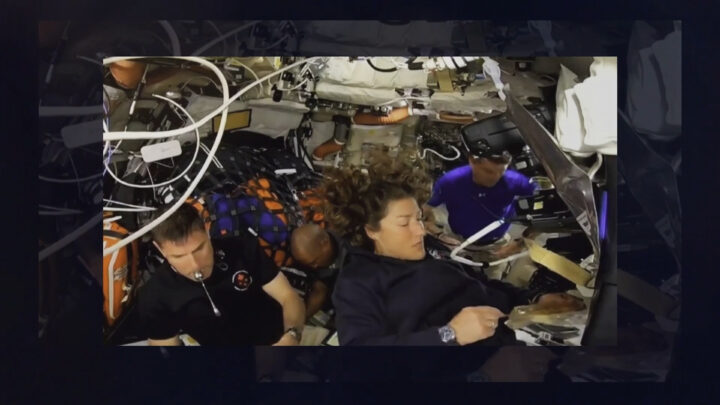
The ten-day Artemis II lunar flyby is not a scientific endpoint — it’s the beginning of a data-gathering effort that will take years to fully analyse. Radiation physicist Dr Mitra Safavi Naeini outlines the hard limits of what a single short mission can resolve, and what the measurements taken aboard Orion will contribute to designing the habitats, shelters, and operational protocols for every future mission to the Moon and beyond.
Artemis II has been called a return to the Moon. And in a sense it was — the first time humans have flown to lunar distance since 1972. But from a scientific and programmatic standpoint, it might be more accurate to call it the first step in a long transition from short lunar sorties to permanent human operations beyond Earth orbit.
Radiation science sits at the heart of that transition, and Dr Mitra Naeini from ANSTO continues her analysis by being clear-eyed about what a ten-day flyby can and can’t tell us.
What it can’t tell us is substantial. A mission of this duration and profile cannot resolve the question of long-term cancer risk from chronic heavy-ion exposure. It can’t quantify the biological risks associated with months-long deep space transit, it can’t characterise the radiation environment on the lunar surface, where the Moon blocks roughly half the sky but simultaneously becomes part of the problem — galactic cosmic rays striking the regolith generate secondary neutrons that scatter upward. And it certainly can’t produce a definitive “safe dose” limit for exploration. That number doesn’t yet exist, and one short mission won’t generate it.
But what Artemis II can do is considerably important. It generates real in-flight measurements of the radiation field inside Orion, in actual deep space, across the real mission trajectory. That data can be compared against pre-flight models to validate how accurately those models predict the environment. The upgraded German M-42 EXT heavy-ion detectors on this mission delivered higher resolution data than anything collected on Artemis I and linking that physical dosimetry data to the biological and performance measurements collected simultaneously begins building the framework for understanding how a given dose translates into actual biological risk in a real crew.
Flight data gives you the real mixed-field environment; ground facilities give you the experimental control to understand it.
Under the updated NASA architecture, Artemis III is now planned as an Earth-orbit systems demonstration, with Artemis IV targeting the first actual lunar surface landing. The radiation data from Artemis II feeds directly into designing those missions — how landers and surface habitats are configured, where crews shelter during solar events, how much shielding makes sense in different geometries.