

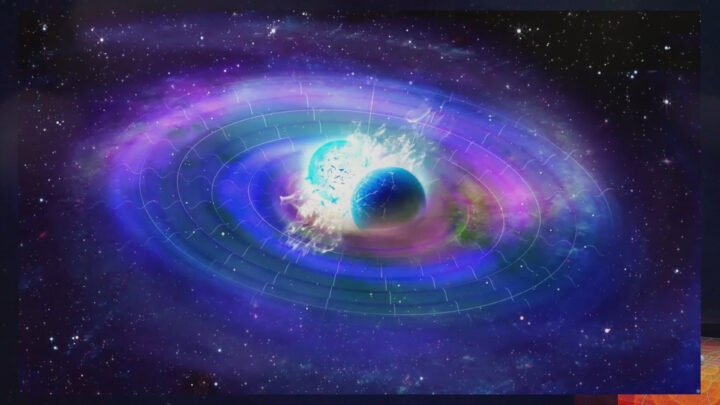
A Monash University-led international team has found compelling evidence for the long-predicted pair-instability mass gap — a range of black hole masses between roughly 50 and 130 solar masses that physics says cannot be produced by dying stars. Using data from LIGO, Virgo, and KAGRA’s fourth observing catalog, researchers confirmed that heavier black holes in binary mergers appear to be second-generation objects: products of earlier collisions rather than direct stellar collapse.
There’s a gap in the universe — a forbidden zone where black holes simply shouldn’t exist and after decades of searching, researchers have finally found compelling observational evidence that it’s real.
The study, published in Nature and led by Monash University’s OzGrav gravitational wave research group, draws on the fourth Gravitational-Wave Transient Catalog — or GWTC-4 — assembled by the LIGO, Virgo, and KAGRA detector collaboration.
Here’s the background. When a massive star exhausts its fuel, it collapses, explodes in a supernova, and leaves behind a black hole. That’s the standard picture. But stellar physics predicts that stars in a certain mass range — those with helium cores between roughly 40 and 130 solar masses — experience something far more violent. Rather than producing a remnant, they undergo what’s called a pair-instability supernova. The core gets so hot that gamma rays spontaneously produce electron-positron pairs, which reduces the radiation pressure, triggering a catastrophic implosion and then an explosion so energetic that the star is completely destroyed. Nothing left behind. No black hole at all.
The consequence of that physics is a predicted “pair-instability mass gap” — a range of black hole masses, roughly 50 to 130 solar masses, that can’t be produced by the direct collapse of a single star. Any black hole in that range had to form through another route — most likely the hierarchical merger of two smaller black holes.
This gap was first predicted in the 1960s, and it’s been difficult to confirm observationally because you need enough gravitational wave detections to map the population statistics. With GWTC-4, there are now enough events.
The Monash-led analysis found clear evidence for the gap in the distribution of secondary — or smaller — black hole masses in binary mergers. The lower boundary appears to sit around 40 to 50 solar masses. And black holes found above that threshold in the secondary position are systematically absent from what direct stellar collapse would predict.
The picture that emerges is of a two-tier black hole population. Most detections come from black holes formed directly from dying stars, below the gap. But some heavier black holes — particularly the primary objects in mergers — appear to be hierarchical products: second-generation black holes built from earlier collisions, likely in dense stellar environments like globular clusters.
This confirmation matters for multiple reasons. It validates decades of stellar evolution modelling. It constrains the nuclear physics of massive star interiors. And because the mass gap edge provides a known reference point in the black hole mass spectrum, it has potential applications as a cosmological tool — a kind of calibrated signpost for measuring the expansion of the universe.
Gravitational wave astronomy keeps turning theory into observation. And the universe, it turns out, really does have rules about which black holes it’s willing to make.