Saturday, August 9 2025
•Matt
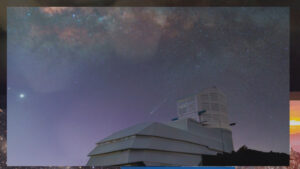
Australian Astronomical Optics at Macquarie University and the Centre for Astrophysics & Supercomputing at Swinburne University of Technology have partnered to process a cosmic data deluge from Chile's new Rubin Observatory, supporting the world's largest sky survey capturing 20 terabytes nightly.

Friday, August 8 2025
•Matt
Gilmour Space Technologies has completed the maiden test launch of Australia’s first locally designed and built orbital rocket — and while it didn’t make it very far, it did achieve...

Friday, August 8 2025
•Matt
The University of Sydney Rocketry Team was announced as the winner of the 2025 International Rocket Engineering Competition back in June, taking out first place with their latest rocket, Pardalote.

Thursday, August 7 2025
•Matt
Gilmour Space Technologies has completed the maiden test launch of Australia's first locally designed and built orbital rocket -- and while it didn't make it very far, it did achieve several mission targets.

Friday, July 11 2025
•Matt
A powerful new telescope expected to unlock deep mysteries of the cosmos and our place within it, has released its first images.

Thursday, July 10 2025
•Matt
As space travel becomes a real possibility for longer missions, including journeys to Mars, scientists are looking more closely at how space conditions affect health. A new study in mice has found living in zero gravity can lead to periodontitis, a common and serious condition where the gums become inflamed and the bone that supports teeth starts to break down, eventually leading to tooth loss.

Wednesday, July 9 2025
•Matt
A new Swinburne research paper delves into the ethical, legal and social issues involved in asteroid mining and planetary defence. It highlights the need for a framework or governing body to be established to protect civilisation.

Tuesday, July 8 2025
•Matt
As NASA prepares to send astronauts back to the moon for the first time in over 50 years, new research from the University of Technology, Sydney has found that lunar dust is less harmful to human lung cells than previously feared, and significantly less toxic than common Earth-based air pollution.

Monday, July 7 2025
•Matt
A new filter for infrared light could see scanning and screening technology tumble in price and size. Built on nanotechnology, the new heat-tunable filter promises hand-held, robust technology to replace current desktop infrared spectroscopy setups that are bulky, heavy and cost from $10,000 up to more than $100,000.

Friday, July 4 2025
•Matt
The James Webb Space Telescope has eye spied two small exoplanets orbiting a young Sun-like star, a mere 310 light years away, say international researchers.

Thursday, July 3 2025
•Matt
The chance that our Milky Way Galaxy will collide with the Andromeda Galaxy may not be as certain as previously thought, according to Aussie researchers, who say that a new simulation has found a 50% chance that there will be no collision between the two galaxies in the next 10 billion years.

Wednesday, July 2 2025
•Matt
On a quest to understand how planets are formed – and ultimately how Earth fits into the cosmic picture – astronomers have uncovered the chemical composition of an exoplanet 850 lightyears away with unprecedented precision.

Tuesday, July 1 2025
•Matt
Stars in close binary systems can exhibit unexpectedly high levels of magnetic activity, according to Australian and international researchers. This activity, responsible for flares and sunspots, is usually powered by the star's rotation, with magnetic activity higher in faster spinning stars, but only up to a known limit.

Monday, June 30 2025
•Matt
Astronomers from the International Centre for Radio Astronomy Research have made a discovery of a new cosmic phenomenon: ASKAP J1832-0911. This object emits pulses of radio waves and X-rays for two minutes every 44 minutes, marking the first detection of long-period transients in X-rays. This finding promises to shed light on similar mysterious signals observed in the Universe.

Monday, June 23 2025
•Matt
Astronomers from the International Centre for Radio Astronomy Research have made a discovery of a new cosmic phenomenon: ASKAP J1832-0911. This object emits pulses of radio waves and X-rays for...

Friday, June 20 2025
•Matt
Astronomers have found that it is not how much gas a galaxy has, but where that gas is located, that determines whether new stars form.

Thursday, June 19 2025
•Matt
A Microsoft artificial intelligence called Aurora can outperform existing Earth system forecasts, according to international scientists.

Wednesday, June 18 2025
•Matt
Creating new drugs or medical treatments are some of the great promises of quantum computing. Scientists at the University of Sydney have, for the first time, used a quantum computer to simulate the chemical dynamics of real compounds, a vital step towards modelling more complex molecules and designing bespoke chemicals that could lead to improved sunscreen or skin cancer treatments.

Tuesday, June 17 2025
•Matt
International researchers have predicted gravitational waves produced by two black holes with what an associated editorial has called "landmark precision".

Monday, June 16 2025
•Matt
For thousands of years, Australians have been looking up at our stars, observing and interpreting star positions for their daily life. Today, Australia has one of the world’s highest rates...
Monday, June 16 2025
•Matt
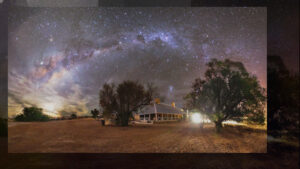
For thousands of years, Australians have been looking up at our stars, observing and interpreting star positions for their daily life. Today, Australia has one of the world's highest rates of light pollution per person.

Friday, June 13 2025
•Matt
The Moon's nearside, the side facing Earth, is dark-coloured and dominated by ancient lava flows, whereas the farside is more rugged - and NASA researchers now suggest it's due to a wonky lunar interior.

Thursday, June 12 2025
•Matt
An international study featuring scientists from Curtin University's School of Earth and Planetary Sciences and Space Science and Technology Centre offers new insights into the Moon's history and provide a better understanding of what lies beneath its cratered surface.

Thursday, June 12 2025
•Matt
Please be advised that due to substantial issues detected with the plug in we bought to manage the poll this year, we have trashed it (unable to fix) and moved...

Wednesday, June 11 2025
•Matt
Increasing greenhouse gases in our atmosphere may reduce the total number of satellites that can safely orbit the planet, say UK researchers who used computer simulations of the atmosphere to work out the number of satellites that could be maintained sustainably in Earth's orbit by the year 2100 under different emissions scenarios.

Tuesday, June 10 2025
•Matt
A pioneering study has delivered transformative insights into the behaviour of colloidal particles under microgravity.
Monday, June 9 2025
•Matt
After years of planning, development and construction on two continents – the Australian piece of the Square Kilometre Array puzzle has taken flight with spectacular images of the early universe...
Monday, June 9 2025
•Matt
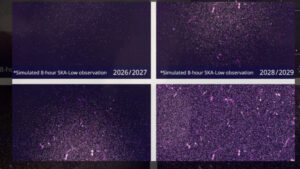
The first image from the international Square Kilometre Array Observatory's telescope in Australia, SKA-Low, has been released marking a significant milestone in its quest to reveal an unparalleled view of our Universe.

Friday, June 6 2025
•Matt
Researchers have developed a new AI algorithm, called Torque Clustering, that significantly improves how AI systems independently learn and uncover patterns in data, without human guidance.
Friday, June 6 2025
•Matt
Members have first play access to two great Talkin' Science Deep Dives focusing on Western Australian astronomy achievements.

Thursday, June 5 2025
•Matt
A team of international researchers has developed an innovative approach to uncover the secrets of dark matter in the cosmos. University of Queensland PhD student Ashlee Caddell co-led a study in collaboration with Germany's metrology institute that searched for dark matter using atomic clocks and cavity-stabilized lasers.

Wednesday, June 4 2025
•Matt
The mantle of the far side of the Moon is likely drier than the near side, according to international researchers who say this could help us understand how the Earth's companion formed.