Wednesday, January 28 2026
•Matt
A study conducted by researchers from Murdoch University in Australia and Dalian Ocean University in China has found that offshore windfarms can improve marine ecosystems and diversify aquatic food chains.

Tuesday, January 27 2026
•Matt
Approximately 96% of the images from some space observatories in low Earth orbit could be tainted over the next decade due to light contamination from satellites, according to an analysis published in Nature. The findings suggest that light pollution from satellites orbiting Earth needs to be minimized for successful astronomical research.

Monday, January 26 2026
•Matt
Curtin University researchers have helped uncover evidence of a mysterious giant asteroid impact, hidden not in a crater but in tiny pieces of glass found only in Australia.

Friday, January 23 2026
•Matt
Using the James Webb Space Telescope and data from Chile's Very Large Telescope, an international astronomy team has uncovered extraordinary images of a rare stellar system called Apep, showing four distinct dust shells spiralling outward from three massive stars locked in a cosmic dance.

Thursday, January 22 2026
•Matt
Quantum satellites currently beam entangled particles of light from space down to different ground stations for ultra-secure communications. New research shows it is also possible to send these signals upward, something once thought unfeasible.

Wednesday, January 21 2026
•Matt
The Hektoria Glacier on the Antarctic Peninsula retreated by at least 8 kilometres in 2 months, a rate nearly 10 times faster than previously measured for a grounded glacier, according to a study published in Nature Geoscience and reported by the Australian Science Media Exchange.

Tuesday, January 20 2026
•Matt
Tiny, solar-powered floating devices that could support instruments in the high atmosphere are described in research published in Nature. The devices could be used for climate monitoring and Mars exploration, without the need for conventional fuel to maintain their altitude.

Monday, January 19 2026
•Matt
In a newly published article, Professor Heidi Newberg from the Rensselaer Polytechnic Institute postulates on the differences between rectangular and circular mirrors.

Saturday, January 17 2026
•Matt
To build a large-scale quantum computer that works, scientists and engineers need to overcome the spontaneous errors that quantum bits, or qubits, create as they operate.

Friday, January 16 2026
•Matt
It may sound futuristic, but international researchers say space-based solar panels could allow us to harvest energy from the sun almost every moment of the day.

Thursday, January 15 2026
•Matt
An exploding star has given researchers a rare chance to find out what the inside of old stars looks like, according to an international study.

Wednesday, January 14 2026
•Matt
Salty ice can generate an electric charge 1,000 times greater than regular ice when strained, according to research published in Nature Materials.

Tuesday, January 13 2026
•Matt
NASA is bringing Crew 11 home from the International Space Station after an undisclosed medical issue. ISS Commander Mike Fincke said the entire crew are "stable, safe and well cared" for with the decision to return home a month early "the right call, even if it's a bit bittersweet"

Tuesday, January 13 2026
•Matt
Martian mudstones from the Jezero crater contain features that improve our understanding of chemical processes on Mars, according to new findings from NASA's Perseverance rover, published in Nature.

Monday, January 12 2026
•Matt
The Deep Extragalactic Visible Legacy Survey, DEVILS, has released its initial data and a series of recent publications explaining how a galaxy's location in the Universe can significantly influence its evolution.

Saturday, January 10 2026
•Matt
Next year humans are set to return to the Moon for the first time in 55 years with the Artemis III mission, and while the astronauts may spend less than 10 days on the lunar surface, scientists around the world are already preparing the next steps: how to live, grow food, and thrive beyond Earth.

Friday, January 9 2026
•Matt
Evidence for a solid inner core in Mars, detected by NASA's InSight mission, is presented in a study published in Nature. It furthers our understanding of the properties and evolution of both Mars and similar planetary bodies.

Thursday, January 8 2026
•Matt
Researchers from The University of Western Australia node at the International Centre for Radio Astronomy Research have uncovered an immense structure, which spans an astonishing 185,000 light-years between galaxies NGC 4532 and DDO 137, located 53 million light-years from Earth.

Wednesday, January 7 2026
•Matt
Fluids may have flowed within the parent body of the near-Earth asteroid Ryugu more than one billion years after it formed, according to research published in Nature.

Tuesday, January 6 2026
•Matt
A world-first study has proven microbes essential for human health can survive the extreme forces of space launch.

Monday, January 5 2026
•Matt
Astronomers hunting for evidence of the light from the first stars and galaxies have found that the Universe was warm, rather than cold, before it "lit up".

Saturday, December 27 2025
•Matt
One of the most powerful black holes in the universe is belching out gas at speeds of up to 10,000 kilometres per second, making its estimated mass more than 10 times lower than first thought.

Friday, December 26 2025
•Matt
Physicists in Australia and Britain have reshaped quantum uncertainty to sidestep the restriction imposed by the famous Heisenberg uncertainty principle – a result that could underpin future ultra-precise sensor technology used in navigation, medicine and astronomy.

Wednesday, December 24 2025
•Matt
Some exoplanets may produce water during their formation via reactions between rocks and hydrogen, according to new research in Nature. The findings offer insight into why some exoplanets have water on their surface.

Tuesday, December 23 2025
•Matt
An international team of scientists from the LIGO, Virgo, and KAGRA collaborations, including researchers from the ARC Centre of Excellence for Gravitational Wave Discovery, has detected two remarkable black hole collisions that are offering new insights into both the evolution of the cosmos and the nature of dark matter.

Monday, December 22 2025
•Matt
Australia's SpIRIT nanosatellite has successfully completed the initial phase of its mission, marking a milestone achievement for Australia's place and reputation in the global space industry.
Friday, December 19 2025
•Matt
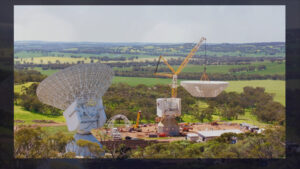
The European Space Agency has expanded its capability to communicate with scientific, exploration and space safety missions across our Solar System with the inauguration of a new 35-m diameter deep space antenna – the fourth for Estrack, ESA's deep space tracking network.
Thursday, December 18 2025
•Matt
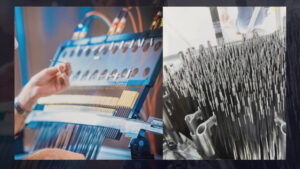
An astronomical instrument featuring Australian-built technology has achieved first light – the crucial moment when a telescope captures its first images – at the European Southern Observatory's Paranal Observatory in Chile.

Wednesday, December 17 2025
•Matt
Scientists from The Australian National University have analysed signals generated by the vibrations of traffic along the Federal Highway to learn more about the seismic nature of Lake George, situated north-east of Canberra.

Wednesday, December 17 2025
•Matt
Evidence of lightning on Mars, detected in sounds and electrical signals captured by NASA's Perseverance rover, is presented in a paper published in Nature.

Tuesday, December 16 2025
•Matt
At the end of last month, Brisbane based rocket manufacturer, AtSpace, entered the rocketry record books by successfully launching their Australian-made A01 rocket higher than any other Australian commercial rocket has gone before.

Monday, December 15 2025
•Matt
A pair of Sydney PhD students helped sharpen the view of humanity’s most powerful space observatory – without leaving Earth. The remarkable technical breakthrough saw the development of a software...